
Home › Dentist-recommended oral care
Dentist-recommended oral care for what you want to treat
Tap what's bothering you, answer a few quick questions, and get a toothpaste-and-rinse routine designed by a licensed dentist. Everyday items go straight to your cart; for prescription-strength items, a dentist licensed in your state reviews a short health form before anything ships.

I review every prescription order myself — same judgement I'd use with you in the chair.Dr. Azar Sona Saeidi, DMDPracticing dentist · Soothing Dental, San Francisco
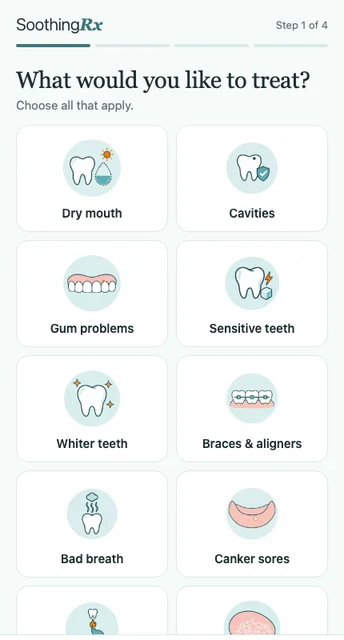
What happens next
- Tap what you want to treatDry mouth, cavities, gums, sensitivity and more
- Answer a few quick questionsFlavors that burn, allergies
- Get your routineA dentist reviews prescription items before they ship
How it works
Tap what you want to treat
Pick one concern or several.
Answer a few quick questions
Things like flavor sensitivities and allergies, which change what fits you.
See your suggested routine
Keep what you want, remove what you don't.
Check out
Everyday items go straight to the cart. Prescription items first need a short, confidential health form and your signature; a dentist licensed in your state reviews it before the item ships. You pay on our store.
We check your state at checkout: prescription items that can't ship to your state are marked unavailable. See the states where our dentist is licensed, or read how buying prescription toothpaste online works.
What dentists recommend for everyone
For most adults, dentists recommend a fluoride toothpaste with the ADA Seal of Acceptance, brushing twice a day for two minutes, cleaning between your teeth once a day, and regular checkups. If that's all you need, you don't need anything stronger. Dentists go further when there's a specific problem: frequent new cavities, a dry mouth, exposed roots, braces, or gums that bleed. That's what the routines below are for.
When a regular toothpaste isn't enough
Prescription-strength toothpaste has about five times the fluoride of a regular one. It's worth it for higher-risk mouths; here's how the four 5,000 ppm options compare.
Dry mouth: the spray, rinse and toothpaste dentists recommend
A dry mouth is uncomfortable, and because saliva protects teeth, it also raises the risk of cavities. Dentists usually pair something that moisturizes (a coating spray and a calcium-phosphate rinse) with an alcohol-free rinse and extra fluoride.
A routine may include
- A moisturizing spray plus rinse (the Aquoral + SalivaMAX duo)
- A gentle, alcohol-free daily rinse
- An SLS-free 5,000 ppm fluoride toothpaste, if you've had new cavities
Pills that stimulate saliva aren't part of this routine; ask your physician or dentist about them.
See a dentist in person if your dry mouth started with a new medicine (don't stop it yourself; ask the prescriber about alternatives), or comes with dry eyes or trouble swallowing.
Cavities: high-fluoride toothpaste and at-home fluoride
If you keep getting new cavities, dentists often recommend a 5,000 ppm (1.1% sodium fluoride) toothpaste in place of your regular one. It's prescription-only in the US, so a licensed dentist reviews your health form first.
A routine may include
- A 5,000 ppm fluoride toothpaste, matched to flavor and sensitivity
- A fluoride gel at bedtime or a once-a-week fluoride rinse, depending on your answers
High fluoride helps prevent new cavities and can help early white spots remineralize. If you prefer fluoride-free, a fluoride-free enamel cream is an option, but fluoride protects high-risk teeth better.
See a dentist in person if you have a toothache or a cavity that has broken through the enamel; that still needs a filling.
Gum problems: rinses for bleeding, swollen or receding gums
Gums that bleed when you brush are usually reacting to plaque. For gums that are a little irritated, dentists often suggest a gentle, alcohol-free daily rinse; for gums that bleed often or are swollen, a stronger activated rinse. Don't use the two together.
A routine may include
- A gentle, alcohol-free daily rinse, or a stronger activated rinse for gums that bleed often
- After a deep cleaning or gum surgery: a prescription 0.12% chlorhexidine rinse for 1–2 weeks, then back to a daily rinse
- A stannous fluoride rinse if roots are exposed or cold-sensitive
A rinse supports professional cleanings; it doesn't replace them.
See a dentist in person if gums are swollen and painful, teeth feel loose, or you see pus.
Sensitive teeth: desensitizing toothpaste and enamel care
Sensitivity to cold or sweets often comes from worn enamel or gums that have pulled back from the root. Dentists typically recommend a desensitizing toothpaste with potassium nitrate, plus a calcium-phosphate enamel cream that you rub on and leave for a few minutes.
A routine may include
- A desensitizing toothpaste (prescription-strength versions add 5,000 ppm fluoride)
- A calcium-phosphate enamel cream
Desensitizing toothpastes usually need a few weeks of daily use to work.
See a dentist in person if pain is sharp when you bite, lingers after cold, or one tooth suddenly hurts. These can be a crack or a cavity.
Whiter teeth: whitening gel for your custom trays
Dentist-dispensed whitening gels are used in custom trays that fit well: a hydrogen peroxide gel for shorter daytime wear, or a carbamide peroxide gel overnight that's gentler on sensitive teeth.
A routine may include
- A whitening gel, for adults who confirm their trays fit and they have no cavities that need filling, no heavy gum recession or gum infection, and aren't pregnant or breastfeeding
- An enamel cream for sensitivity, and an enamel serum after whitening
- No well-fitting trays? A whitening toothpaste instead
Whitening doesn't change the color of crowns, fillings or veneers.
See a dentist in person if you have untreated cavities, gum disease or a lot of sensitivity before you start.

Braces and aligners: protect your enamel during and after treatment
Brackets and attachments trap plaque, which is why white spots (early enamel damage) are common after braces. During treatment, dentists often recommend a single high-fluoride toothpaste.
A routine may include
- A high-fluoride toothpaste during treatment
- After brackets or attachments come off: a calcium-phosphate cream for white spots
Interested in at-home devices used during treatment (vibration or light therapy)? Check with your orthodontist first.
See a dentist in person if a bracket or wire breaks, or a tooth hurts more than the usual soreness after an adjustment.
Bad breath: rinses that target the odor
Most bad breath starts in the mouth: bacteria on the tongue and around the gums make sulfur compounds. Dentists often start with a gentle chlorine-dioxide rinse that neutralizes them, and step up to a stronger activated rinse if odor persists, never both together.
A routine may include
- A gentle chlorine-dioxide rinse, or a stronger activated rinse if odor persists
- If the cause is a dry mouth or gum problems, those routines too
Clean your tongue daily too.
See a dentist in person if your breath stays bad despite good cleaning. It can come from tonsil stones or from sinus or stomach issues.

Canker sores: a gentle, SLS-free routine
If you get canker sores often, dentists commonly suggest avoiding sodium lauryl sulfate (SLS), the foaming agent in many toothpastes. Studies suggest an SLS-free toothpaste can mean fewer, shorter and less painful sores for people prone to them.
A routine may include
- An SLS-free fluoride toothpaste
- A gentle, alcohol-free rinse that doesn't sting
Stronger antiseptic rinses are held off while you have an open sore unless a dentist directs them. It's a comfort routine, not a cure.
See a dentist in person if a sore lasts two weeks or more, is unusually large, keeps coming back, or comes with a fever or trouble eating.
Acid reflux: protect your enamel from stomach acid
Stomach acid that reaches the mouth can slowly wear enamel, often on the inner surfaces of the upper teeth. Dentists typically suggest a high-fluoride toothpaste with a raised pH and nano-hydroxyapatite to help protect it.
A routine may include
- A high-fluoride toothpaste with a raised pH and nano-hydroxyapatite
Rinse with water after reflux and don't brush right away. This protects your teeth; treating the reflux itself stays with your physician.
See a dentist in person if teeth look worn, chipped or more sensitive than before.

Oral lichen planus: a soothing, low-irritation routine
Oral lichen planus is a long-term inflammatory condition that should be diagnosed and monitored by a dentist or oral medicine specialist. For comfort, dentists usually recommend skipping alcohol rinses, strong mint and SLS toothpastes.
A routine may include
- An unflavored or mild alcohol-free rinse
- An SLS-free fluoride toothpaste
It soothes tissue; it doesn't replace a prescription steroid if you need one.
See a dentist in person if a patch is new or changing, a sore won't heal, or you find a lump.
When to see a dentist in person instead
- A toothache, swelling, a fever or an injury
- A broken or loose tooth
- A sore or patch that lasts two weeks or more, or keeps changing
- Anything that is getting worse
We provide only non-controlled, topical dental products you use yourself, such as toothpastes and rinses. We can't prescribe antibiotics or pain medicine. In an emergency, call 911.
Who designs and reviews your routine
About Dr. Azar Sona Saeidi, DMD
Cofounder of Soothing Dental in San Francisco's Financial District. DMD magna cum laude, Boston University Goldman School of Dental Medicine. Practicing in California since 2011 (license #60566). Member of the American Dental Association, California Dental Association, and San Francisco Dental Society.

Frequently asked questions
Which toothpaste and mouthwash do dentists recommend?
For most people, a fluoride toothpaste with the ADA Seal of Acceptance twice a day, plus cleaning between the teeth daily. Many people don't need a mouthwash at all. Dentists add targeted products for specific problems, such as a high-fluoride toothpaste for frequent cavities or an alcohol-free rinse for a dry or irritated mouth. The routine builder matches those to your answers.
Is the routine builder a diagnosis?
No. It suggests a routine based on what you tell it; it doesn't examine your mouth. Keep your regular checkups, and see a dentist in person for pain, swelling or anything getting worse.
How does the dentist review work?
Some items, like 5,000 ppm fluoride toothpaste or 0.12% chlorhexidine rinse, are prescription-only in the US. If your routine includes one, you fill in a short, confidential health form and sign it. A dentist licensed in your state reviews it, and the item ships only if it's appropriate for you.
Does the dentist's review cost extra?
No. The review is included; you pay the product prices at checkout plus shipping.
Can you ship prescription items to my state?
Only to states where our dentist is licensed (see the current list on our teledentistry services page). We check your state at checkout and mark anything that can't ship there as unavailable.
Can you prescribe antibiotics or pain medicine?
No. We provide only non-controlled, topical dental products you use yourself, such as toothpastes and rinses. For a toothache, swelling, fever, an injury or a sore that won't heal, see a dentist in person. In an emergency, call 911.
Should I use mouthwash before or after brushing?
It depends on the products. With a high-fluoride (5,000 ppm) toothpaste, adults should spit and not rinse, eat or drink for 30 minutes so the fluoride stays on the teeth. Use your rinse at a different time of day. Your routine includes directions for each product.
Does SLS in toothpaste cause canker sores?
Not in everyone. But studies suggest people who get canker sores often may have fewer, shorter and less painful sores with an SLS-free toothpaste. That's why the canker-sore routine uses one, with a gentle alcohol-free rinse.
What helps dry mouth?
Sip water, limit alcohol and caffeine, and skip alcohol-based mouthwash. Dentists often add a saliva substitute (spray or rinse) and extra fluoride, because a dry mouth gets cavities more easily. If it started with a new medicine, ask the prescriber about options rather than stopping it.
Is prescription toothpaste worth it?
For higher-risk mouths (frequent new cavities, dry mouth, exposed roots, braces), dentists often recommend a 5,000 ppm toothpaste. If you rarely get cavities, a regular fluoride toothpaste is usually enough.
See also: teledentistry services · service agreement and informed consent · notice of privacy practices
Ready? Tap what you want to treat
About two minutes. For guidance, not a diagnosis. A licensed dentist reviews prescription items before they ship.
Find my routineThis page is educational and is not a diagnosis. Prescription products are reviewed by a licensed dentist before they ship, and only to states where the dentist is licensed (see teledentistry services).