

Blog › Early cavities
Reverse Early Cavities & White Spots Without Drilling Guide
Early lesions can be reversed — but only some of them, and the window matters. Two questions and we'll tell you which therapy your spots need.
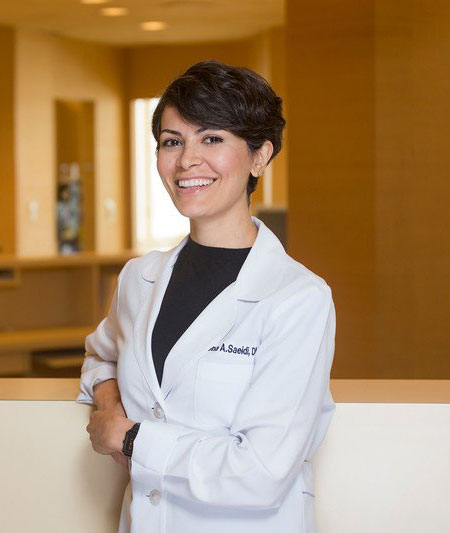
I review every prescription order myself — same judgement I'd use with you in the chair.
Dr. Azar Sona Saeidi, DMDPracticing dentist · Soothing Dental, San Francisco
Find the right white-spot treatment
Two questions · about 20 seconds
Where are you in the process?
Tap all that apply — timing changes what will actually work
Uses Dr. Saeidi's own decision rules
What matters most?
Tap any that apply
Opens store.soothing.dental — our online store, same practice. A licensed dentist reviews the order before it ships.
Call (415) 630-6534 or book a consultation.
The short version
- An “early cavity” has not broken through the enamel surface yet — that is what makes reversal possible.
- Four therapies exist, from at-home remineralization to in-office resin infiltration.
- Age of the spot decides more than anything else how well it responds.
- Diet is the lever most patients underestimate.
You can reverse cavities without drilling — but only if you catch them early. Most patients hear the words "you have a cavity" and assume the next step is a drill, an injection, and a filling. Currently, that is no longer the only path. If a cavity is caught before it has tunneled through the enamel and into the dentin, there is a real, evidence-based way to reverse cavities without drilling. The same is true for the chalky white spots that appear after braces, after Invisalign, or in patients with a high-sugar diet and dry mouth. They are the visible footprint of demineralization, and they can be remineralized.
I am Dr. Sona Saeidi, and at Soothing Dental in San Francisco I have built a clinical workflow specifically around catching and treating these early lesions before they become drill-and-fill restorations. This guide walks through every modality I use — Curodont peptide therapy, Icon resin infiltration, MI Paste with CPP-ACP, prescription fluoride, and the at-home daily routine that ties them all together — and tells you when each one is the right call.
What "early cavity" actually means
Tooth enamel is roughly 96% mineral by weight, mostly hydroxyapatite. Every day, that mineral is in flux: when the mouth's pH drops below 5.5 (after a soda, a smoothie, dried fruit, or in a dry-mouth environment), calcium and phosphate leach out of the crystal lattice. When pH rebounds and saliva delivers calcium, phosphate, and fluoride back to the surface, the lattice rebuilds. Decay only happens when demineralization wins this tug-of-war over weeks and months.
Before a cavity becomes a hole, it goes through a "white spot lesion" stage. The enamel surface is still intact, but the subsurface layer has lost mineral. Light scatters differently through the porous structure, and the area looks chalky, opaque, or matte instead of glossy. This is the stage where you can reverse cavities without drilling. Once the surface caves in and dentin is exposed, the game changes — bacteria are now in a place your saliva cannot reach, and a restoration is needed.
How a dentist diagnoses a reversible lesion
In my chair, three tools tell me whether a lesion is still reversible. First, a sharp explorer — but used gently. A sticky surface that catches the explorer is concerning, but I do not drill on stickiness alone. Second, transillumination and bitewing radiographs to see how deep the radiolucency extends. If decay is contained to enamel (E1 or E2 on bitewing classification), it is a candidate for non-invasive therapy. Third, laser fluorescence (DIAGNOdent) to quantify mineral loss. Numbers under 20 are typically reversible.
This single variable — how old the spot is — decides your treatment more than any product choice.
The four therapies to reverse cavities without drilling
There is a lot of marketing noise in this space. Charcoal toothpaste does not remineralize. Hydroxyapatite toothpaste helps modestly. The four therapies below have peer-reviewed evidence behind them, and they are what I actually use in clinic.
1. Curodont Repair (peptide self-assembly)
Curodont is the newest tool in the kit and the one I get the most questions about. It is a clear gel containing a synthetic peptide called P11-4. When applied to an etched white spot lesion, the peptide molecules diffuse into the porous subsurface and self-assemble into a three-dimensional scaffold that mimics the structure of natural enamel. Calcium and phosphate from saliva then crystallize onto that scaffold, filling the lesion from the inside out.
The clinical advantages are significant. A single 5-minute application produces remineralization that continues for months. Studies show measurable lesion regression at 3 and 6 months, and unlike fluoride varnish (which works at the surface), Curodont rebuilds the body of the lesion. I use it for moderate white spot lesions, post-orthodontic decalcification, and incipient interproximal cavities visible on bitewings. If you want the deep dive, see my detailed write-up: Curodont — healing interproximal lesions without drilling.
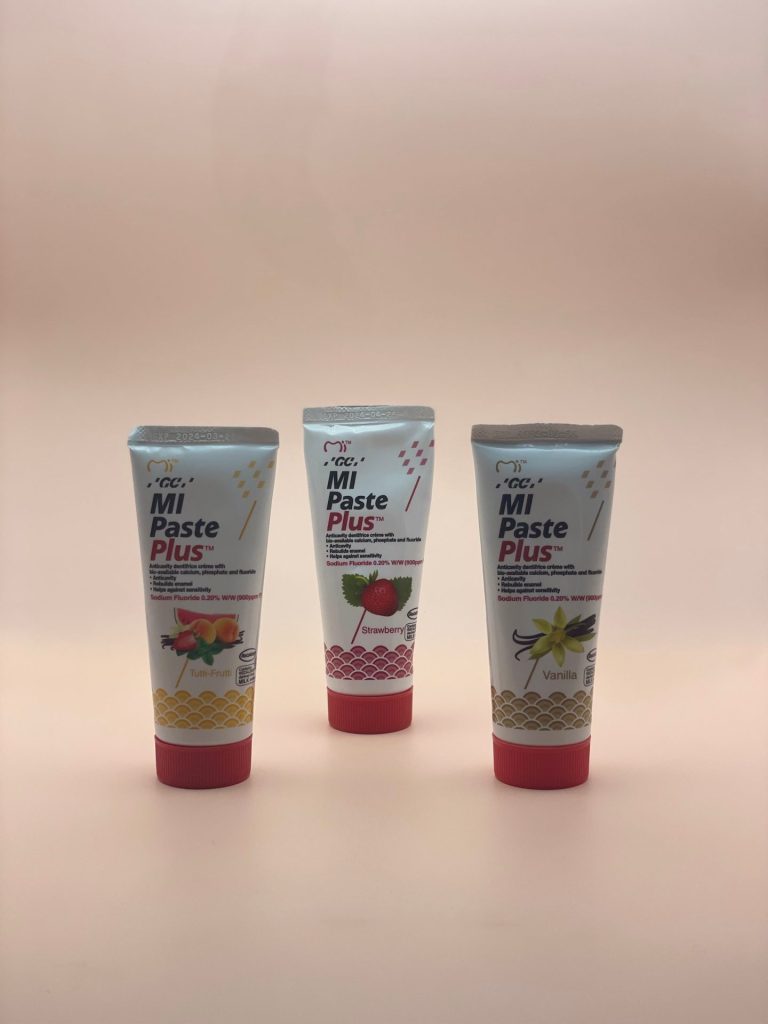
2. MI Paste Plus (CPP-ACP + fluoride)
MI Paste Plus delivers casein phosphopeptide-amorphous calcium phosphate (CPP-ACP) plus 900 ppm fluoride. The CPP-ACP molecule binds to plaque, soft tissue, and the tooth surface, and acts as a calcium-phosphate reservoir. As soon as pH drops, the bound calcium and phosphate are released right where they are needed.
This is my most-prescribed product for at-home daily use. Patients apply a pea-sized amount to the teeth at night after brushing, leave it on, and go to bed. For post-Invisalign white spots, MI Paste in the aligner trays for 5–10 minutes a night is even more effective because it holds the paste against the enamel. You can pick it up at our shop: MI Paste Plus.
3. Icon Resin Infiltration
Icon takes a different approach. Instead of remineralizing the lesion, it infiltrates a low-viscosity resin into the porous enamel and seals it. The lesion is etched with hydrochloric acid gel for 2 minutes (which removes the surface layer that blocks penetration), dried with ethanol, and then the resin is wicked in by capillary action and light-cured.
The result is a sealed lesion that no longer scatters light — the white spot visually disappears in most cases — and is now resistant to further acid attack. Icon is my go-to when the white spot is cosmetic (front teeth, smile line) and the patient wants an immediate visual fix. Read the full breakdown: Icon resin infiltration — how it works for white spot lesions.
4. Prescription fluoride toothpaste (5,000 ppm)
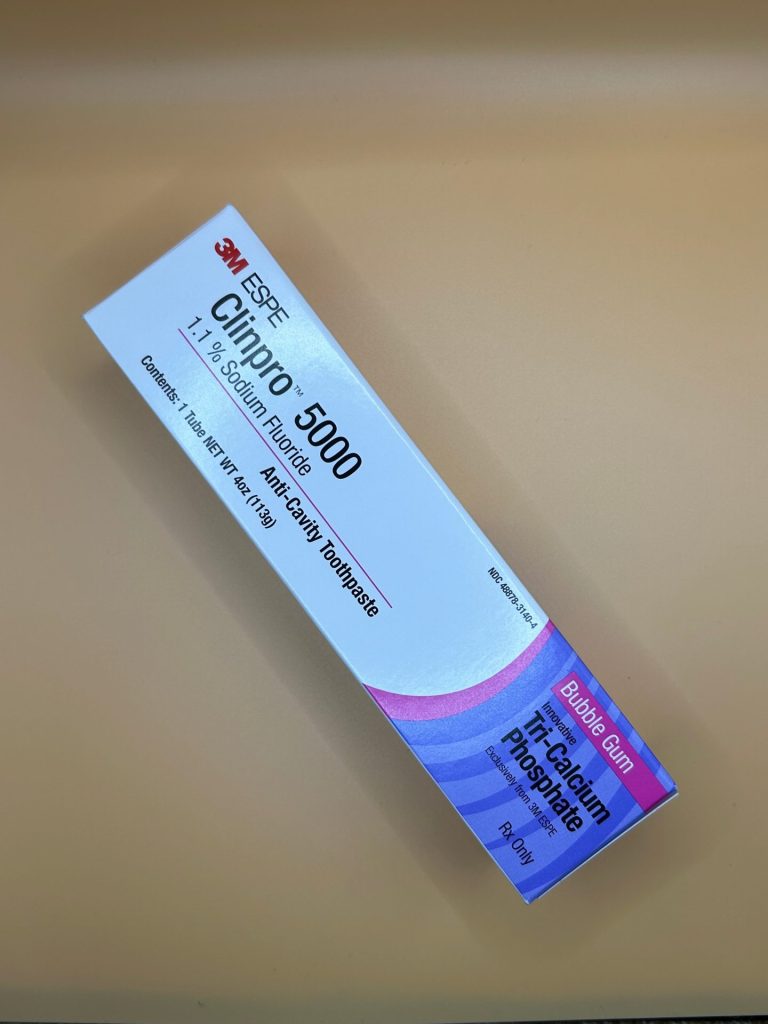
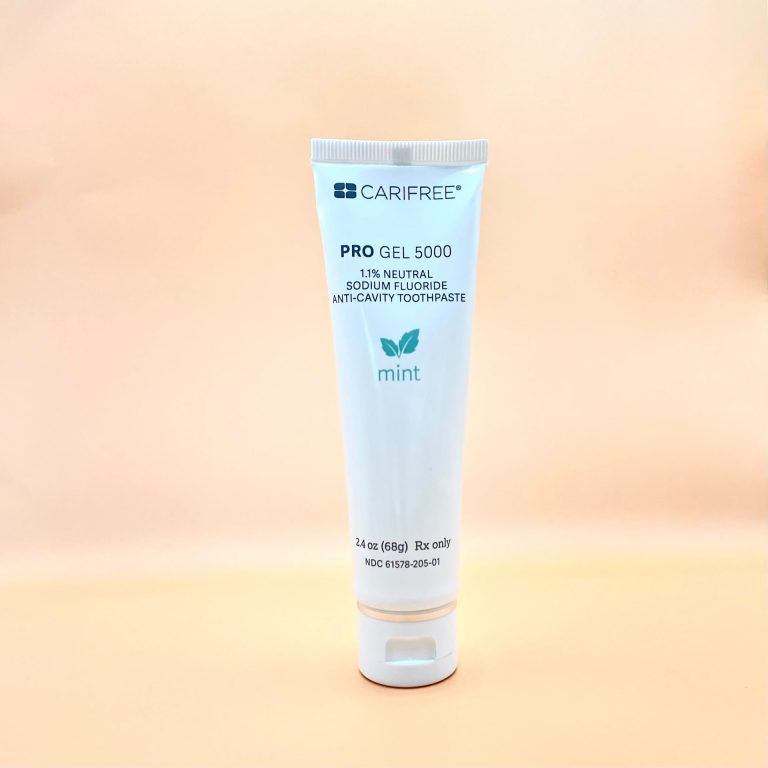
The fourth pillar is high-strength fluoride toothpaste. Over-the-counter pastes are 1,100–1,450 ppm fluoride. Prescription pastes like Fluoridex Daily Defense and Clinpro 5000 deliver 5,000 ppm — roughly 4× the fluoride concentration. For patients with active early lesions, dry mouth, orthodontic appliances, or a history of recurrent decay, this is the daily backbone of the protocol.
Clinpro 5000 also includes tricalcium phosphate (TCP), a calcium source that survives the tube without reacting with the fluoride and only releases on contact with saliva. For mineral-depleted teeth, this is a meaningful upgrade over plain prescription fluoride.
Not sure which one you need? Two questions, about twenty seconds, and Dr. Saeidi's own decision rules point you to one — with the reason.
Find my matchHow I sequence the therapies
The therapies above are not interchangeable. Used in the right sequence, they amplify each other. Here is the decision tree I run in clinic.
Tier 1 — minor white spot, no orthodontic history
A single faint chalky spot, no symptoms, normal saliva flow. The patient gets in-office fluoride varnish, an MI Paste regimen for 8 weeks, and a switch to a 5,000 ppm fluoride toothpaste. This combination resolves about 70% of Tier 1 lesions on its own.
Tier 2 — moderate lesion, post-ortho or active diet risk
A clearly visible white spot, or multiple spots after Invisalign or braces, or a patient with dry mouth or a high-sugar diet. The protocol is Curodont in-office, then 12 weeks of MI Paste at home, then a recheck at 3 months. If the lesion is still visible at the smile line, we add Icon for the cosmetic finish.
Tier 3 — incipient interproximal cavity
A small radiolucency on a bitewing that has not breached the dentin. Historically this was a watch-and-wait scenario; now it is a Curodont scenario. The peptide is delivered between the teeth using a small applicator strip, and the lesion is monitored at 6-month intervals. Many of these stop progressing entirely.
What you can do at home — the daily routine
None of this works without a daily home routine that respects the chemistry. The fundamentals are unchanged from what your dentist has been telling you for years, but the products have improved.
The 8-step home protocol
- Morning brush with a 5,000 ppm fluoride paste for 2 minutes. Spit, do not rinse — let the fluoride sit on the enamel.
- Wait 30 minutes after acidic foods or drinks before brushing. Brushing acid-softened enamel mechanically removes mineral.
- Floss daily — interproximal areas are where most early lesions hide.
- Use a fluoride or xylitol mouthwash midday if you cannot brush.
- Drink water between meals, not constant sipping of coffee, tea, or sparkling water. Each acidic sip restarts the demineralization clock.
- Chew xylitol gum after meals if you cannot brush. Xylitol disrupts S. mutans, the bacterium most responsible for caries.
- Evening brush, again with 5,000 ppm paste. Spit, do not rinse.
- Apply MI Paste Plus before bed. A pea-sized amount, smeared on the teeth with a clean finger or in an aligner tray. Leave it on overnight.
This routine, run daily, is the difference between a stable mouth and a mouth that needs a new filling every two years.
Diet — the lever most patients underestimate
If your enamel is being challenged by acid 8+ times a day, no product can outpace it. The calculation is simple: every acidic exposure starts a 30–40 minute demineralization window. Five sips of cold brew over an hour is not one exposure — it is five. Saliva does its remineralization work between exposures, and you have to give it room.
The patients I see reverse early lesions fastest are the ones who change two habits: they stop sipping acidic drinks all day, and they stop snacking on dried fruit, granola, and crackers between meals. Eat the food, drink the drink, then drink water. Spread your acid exposures into clusters at meals rather than smearing them across the day.
What about hydroxyapatite toothpaste?
Nano-hydroxyapatite (n-HAp) toothpaste is the trendiest product in this category. The science is reasonable — n-HAp particles can occlude exposed dentin tubules and contribute surface mineral. But head-to-head studies against 5,000 ppm fluoride show fluoride still wins on cavity prevention by a meaningful margin. n-HAp is a fine choice for someone who cannot tolerate fluoride or who has very low risk; it is not the right choice for someone with active early decay. For active lesions, fluoride is non-negotiable.
When non-invasive therapy is not the answer
I have to be honest about the limits. If the surface enamel has cavitated — if you can stick a probe into a hole — no peptide, paste, or resin will fix it. Bacteria are now living in a protected reservoir, and the only way out is to clean it mechanically and seal it with a restoration. The same is true for any lesion into dentin. Trying to remineralize a frank cavity is not conservative dentistry; it is malpractice. The right time to reverse cavities without drilling is before the cavity has tunneled in, not after.
Where Soothing Dental fits in
If you have been told you have an early cavity, or you are seeing white spots after Invisalign, or you just want a mouth that does not require a new filling every cleaning, this is exactly the workflow we run. The first visit is diagnostic — bitewings, transillumination, DIAGNOdent if needed — and the conversation is about which tier you fit into. From there we sequence Curodont, MI Paste, Icon, and prescription fluoride to match your specific risk profile. Most patients see visible improvement at the 3-month recheck.
The case for catching decay early
The economics of early treatment matter. A Curodont application runs roughly $200–$400 per quadrant. A standard composite filling runs $250–$450 per tooth, and that filling has a service life — most direct restorations need replacement every 7 to 12 years. Each replacement removes more healthy tooth structure to clean out the old margins. Twenty years and three replacement cycles later, that tooth has lost half its dentin and is on the path toward needing a crown or a root canal.
Reversing decay at the white spot stage breaks this cycle. The tooth stays whole. There is no margin to recur around. The patient never enters the restorative treadmill on that tooth. From a cost-of-ownership perspective over a 30-year horizon, non-invasive therapy is dramatically cheaper than even a single filling, and immeasurably cheaper than the eventual crown or root canal that filling becomes.
Why this conversation has changed
Five years ago, the only reliable tools for incipient decay were fluoride varnish and patient education. Curodont received clearance for U.S. clinical use, Icon adoption expanded into general dentistry, and MI Paste's CPP-ACP technology graduated from "interesting research" into a daily-use staple. Together these created the first realistic alternative to drill-and-fill for early-stage decay. The dentists using all three are quietly producing outcomes that would have been impossible a decade ago.
The shift is also generational. Younger patients want their teeth treated like the rest of their healthcare — preventively, with the least-invasive intervention that actually solves the problem. Drilling out healthy enamel to put in a synthetic plug is a 1950s solution. The solution is to read the early signal, choose the right modality, and let biology do the heavy lifting.
What to expect from a "reverse decay" first visit
If you book with us specifically for early-decay assessment, here is what the first visit looks like. We start with a full set of bitewings if you have not had recent ones, then a clinical exam with magnification loupes and transillumination. If we find suspicious areas, DIAGNOdent gives us a numerical mineral-loss reading. We photograph everything, baseline it in your chart, and walk you through what we are seeing. Treatment recommendations follow the tier system above — and you leave with a written protocol, not a vague "we will keep an eye on it."
If you are already a patient, the same workflow runs at any cleaning appointment when we flag a developing lesion. The difference between a tooth that becomes a filling and a tooth that stays whole is usually whether someone caught the lesion at month six versus month thirty-six. That is the entire game.
Spoke articles in this cluster
- Curodont vs MI Paste — which heals white spots better?
- Icon resin infiltration — how it works for white spot lesions
- White spots after braces or Invisalign — how to get rid of them
Not sure which one you need? Two questions, about twenty seconds, and Dr. Saeidi's own decision rules point you to one — with the reason.
Find my matchFrequently asked questions
Can I really reverse cavities without drilling?
Yes — but only if the cavity is caught at the white spot lesion stage, before it has cavitated through the enamel surface. Once a hole is present, drilling and a restoration are required.
How long does Curodont take to work?
The application is a single 5-minute office visit. Visible remineralization develops over 3–6 months as saliva delivers calcium and phosphate to the peptide scaffold.
Is MI Paste safe to swallow?
Yes. The active ingredient is derived from milk casein and is safe for incidental swallowing in adults. Patients with milk protein allergy should avoid it; for them, RECALDENT-free alternatives exist.
Will my insurance cover any of this?
Fluoride varnish and prescription fluoride paste are usually covered. Curodont and Icon are typically not — they are billed as adjunctive procedures and run a few hundred dollars per quadrant. For most patients, that is dramatically cheaper than the lifetime cost of restoring a tooth.
About Dr. Sona Saeidi, DMD
Cofounder of Soothing Dental in San Francisco's Financial District. DMD magna cum laude, Boston University Goldman School of Dental Medicine. Practicing in California since 2011 (license #60566). Member of the American Dental Association, California Dental Association, and San Francisco Dental Society.
This page is educational and is not a diagnosis. Products sold through Soothing Dental may require a prescription; eligibility is confirmed through a brief telehealth screen at checkout.